
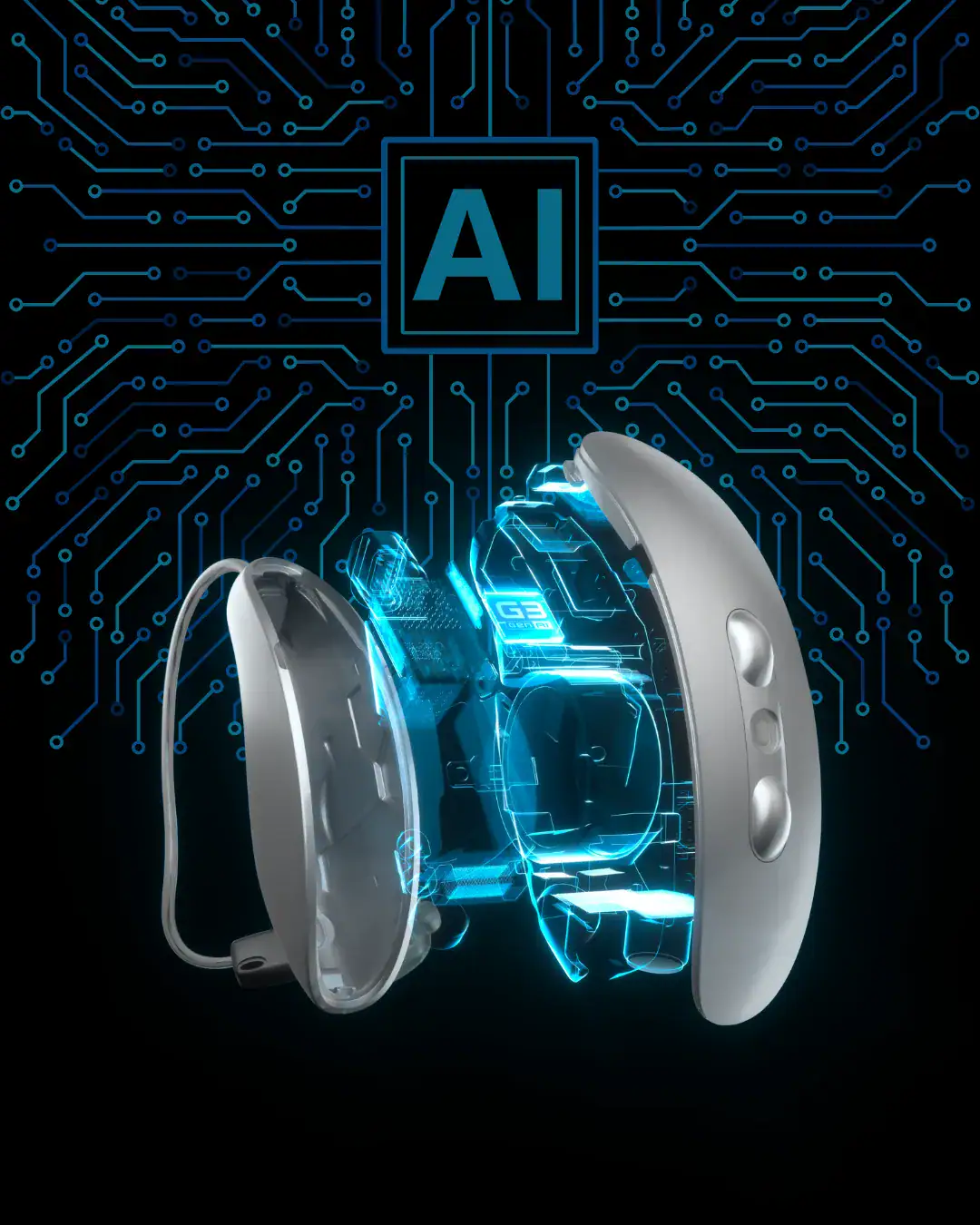
31 Aug AI Hearing Aids: A Technical Deep Dive into DNNs and Chip Architecture
Artificial Intelligence (AI) is now a standard headline in premium hearing aid launches, but the term can obscure more than it explains. The clinically useful questions are what type of AI is being used, where it runs, when it is activated and what evidence supports the claimed benefit.
This article compares the architecture and evidence behind Oticon Reveal, Phonak Audéo EON Sphere, Starkey Omega AI and Widex Allure AI RIC. It is not a league table. Manufacturer research and independent laboratory testing answer different questions, and neither replaces an individually verified fitting.
What AI and DNN Mean in a Hearing Aid
In this context, AI usually refers to a deep neural network (DNN) trained to recognise complex patterns in sound. During development, the model is exposed to examples relevant to its intended task, such as speech, noise, spatial cues or different acoustic scenes. Its parameters are adjusted during training, then the trained model is deployed to the device.
Training versus inference: Training generally occurs off-device before release. In everyday use, the hearing aid performs inference, applying the trained model to incoming sound. A device may adapt its settings from moment to moment without retraining the underlying neural network in the wearer’s ear.
DNN versus conventional processing: Earlier and non-DNN platforms are not simply ‘rule-based amplification’. They can include sophisticated environment classification, directional microphones, compression and digital noise reduction. A DNN adds another pattern-recognition method, potentially allowing more complex distinctions than a hand-designed feature set alone.
The real-time constraint: Processing must occur with low latency, limited power and very little physical space. Manufacturers therefore make different choices about model size, dedicated hardware, activation and the amount of user control.
Four Technical Questions That Separate the Platforms
- Architecture: Does the DNN share the primary hearing aid processor, form part of an integrated platform or run on a dedicated AI co-processor?
- Activation: Is the AI path always active, automatically recruited in specific environments or manually selected by the wearer?
- Optimisation target: Is the model designed mainly for speech-noise separation, directional control, scene classification or balancing speech with broader acoustic context?
- Evidence layer: Is a result drawn from a manufacturer technical study, a peer-reviewed paper, independent electroacoustic testing or a clinical outcome measured in an individual patient?
Technical Comparison
| Device | Core AI approach | Activation | Evidence status (24 Aug 2026) |
| Oticon Reveal | Speech AI and Context AI integrated in the Reveal AI platform | Always on and automatic | · Manufacturer evidence available
· Independent product testing not yet published |
| Phonak Audéo EON Sphere | ERA chip for connectivity plus dedicated HYPERSONIC AI chip for speech-noise separation | Automatically applied in complex noise | · Independent HearAdvisor testing (15 Sep 2026) gives an A grade, with speech in noise a standout |
| Starkey Omega AI | DNN 360 uses multiple neural-network processes for adaptive directionality | Automatic processing plus on-demand Edge Mode+ | · Independent HearAdvisor testing gives an A grade
· Headline percentages are manufacturer-sourced |
| Widex Allure AI RIC | W1 platform plus dedicated AI co-processor for Clarity Boost | Clarity Boost is user activated | · Baseline Allure testing gives an A grade
· Feature-specific studies are primarily Widex-published |
Note: Independent lab results reflect specific devices, couplings, programs and fitting conditions. They do not isolate every AI feature or predict an individual patient’s outcome.
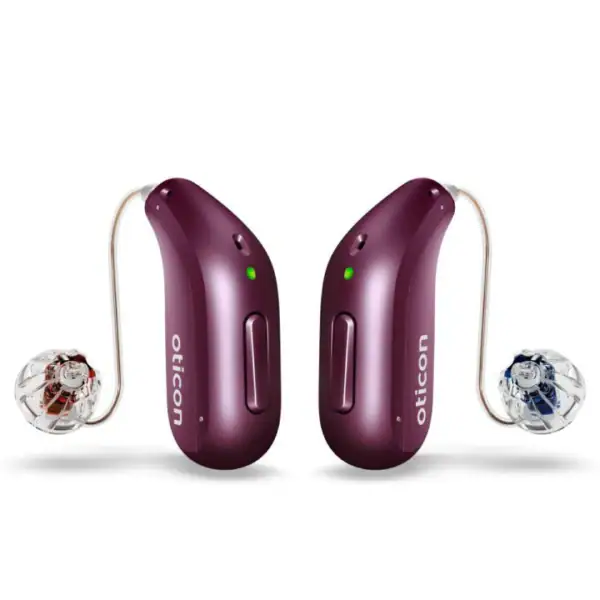
Oticon Reveal: Dual AI on an Integrated Platform
Oticon Reveal introduces two dedicated AI systems within the Reveal AI platform. Speech AI is described as continuously identifying and enhancing speech, while Context AI recognises and balances surrounding contextual sounds. Oticon states that both operate in real time, across environments, without a manual activation state.
The architecture reflects Oticon’s BrainHearing philosophy: speech should be made accessible without removing the contextual information the brain uses to interpret a scene. That is a meaningful design objective, but it should not be confused with independent proof of superiority over competing platforms.
Evidence status: Reveal was announced on 11 August 2026. At the time of writing, performance claims, including the reported 60% stronger brain response, come from Oticon research briefs and have not yet been replicated in independent product testing. The appropriate conclusion is that the architecture is promising and the comparative evidence is still developing.
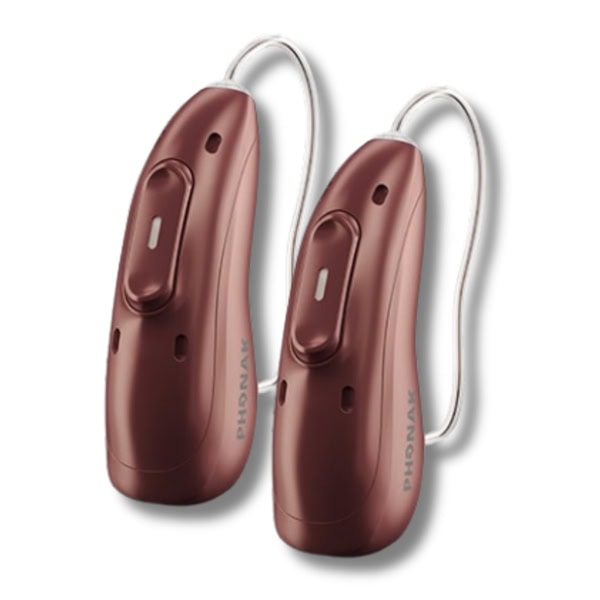
Phonak Audéo EON Sphere: Dedicated AI Hardware
Phonak Audéo EON Sphere uses two chips. The ERA chip supports connectivity functions, including Bluetooth Classic, RogerDirect, binaural communication and Auracast broadcast audio, while the new HYPERSONIC AI chip runs Spheric Speech Clarity 3.0, the DNN Phonak uses to separate speech from noise in real time and from any direction.
HYPERSONIC is the successor to Phonak’s earlier DEEPSONIC chip. Phonak reports that EON is 37% more efficient than its previous generation, with a hearing aid that is 25% smaller and 20% lighter, and up to 38 hours of battery life per charge. These are manufacturer claims tied to particular study conditions, not universal improvements that every wearer should expect.
Independent evidence: HearAdvisor’s September 2026 testing gave Audéo EON Sphere an A SoundGrade, with speech in noise identified as a standout strength. This supports the platform’s intended use case, while still reflecting one laboratory protocol, coupling and fitting condition.
Clinical consideration: Spheric Speech Clarity is automatically recruited in challenging environments; according to Phonak, AutoSense OS AI 8.0 now activates it at lower noise levels and keeps it engaged longer as sound levels fluctuate. Device dimensions, physical fit, connectivity and real-world battery behaviour should be considered alongside its speech-in-noise performance.
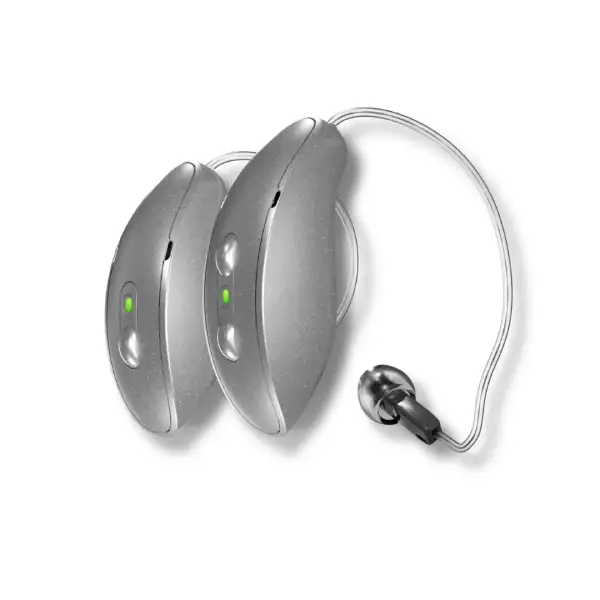
Starkey Omega AI: Adaptive Directionality with On-Demand Control
Starkey Omega AI centres on DNN 360, which uses multiple DNN processes to adapt the directional pattern as the wearer and acoustic scene change. Starkey reports up to 28% improved speech intelligibility and up to 8dB SNR compared with its previous technology. Those figures are manufacturer sourced.
Edge Mode+ adds an on-demand layer that allows the wearer to request additional sound optimisation in a difficult environment. This is clinically relevant for patients who value automatic processing but also want an accessible override through the hearing aid or My Starkey app.
Independent evidence: HearAdvisor gives Omega AI an A SoundGrade in its current testing. That result supports strong overall performance, but it does not independently reproduce Starkey’s 28% or 8dB claims because the methods and comparison conditions differ.
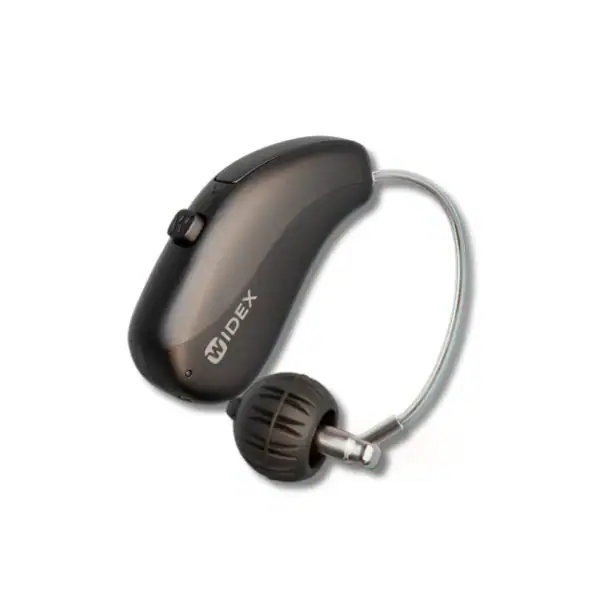
Widex Allure AI RIC: User-Activated AI Co-Processing
Widex Allure AI RIC combines the W1 platform and its established Universal processing with a dedicated AI co-processor for Clarity Boost. Unlike the always-available AI descriptions used by Oticon and Starkey, Clarity Boost is a user-activated program intended to provide extra support in noise.
This architecture preserves Widex’s low-delay, natural-sound approach as the everyday baseline while allowing the wearer to recruit stronger AI-based processing when needed. It also introduces a usability question: the patient must recognise the listening challenge and activate the feature.
Evidence status: Widex-published studies report improved speech intelligibility, listening effort and comfort with Clarity Boost compared with the Universal program under tested conditions. HearAdvisor has given the standard Allure RIC 440 an A SoundGrade, but that baseline test should not be treated as independent verification of Clarity Boost unless the feature and test condition are explicitly matched.
What the Evidence Can and Cannot Tell Us
Chip count does not predict clinical outcome. A dedicated processor can create valuable computational headroom, but architecture alone does not tell us how well the complete system has been trained, tuned or fitted.
Feature-specific testing matters. An overall product score may reflect the automatic program and prescribed coupling, not the manual AI mode highlighted in marketing. Results should be linked to the exact feature and test condition.
Manufacturer and independent studies are not interchangeable. Manufacturer research can explain design intent and measure a feature under controlled conditions. Independent testing offers useful external comparison, but it may use a different fitting formula, acoustic coupling or outcome measure.
New evidence will change the picture. Oticon Reveal and Phonak Audéo EON Sphere have only just entered the market, while firmware, fitting software and test databases continue to evolve. Exact rankings are a snapshot, not a permanent property of a platform.
Why Clinical Assessment and Verification Still Matter More
A technical specification cannot establish whether a hearing aid is appropriate for a particular patient. The decision still depends on the audiogram, speech understanding, ear acoustics, listening goals, cognition, dexterity, connectivity needs and willingness to use manual controls.
Real ear measurement is essential for confirming that the fitted output matches the prescribed target in the patient’s ear. Where the main complaint is difficulty in noise, speech-in-noise assessment and a structured real-world trial can provide information that a pure-tone audiogram or specification sheet cannot.
Jason’s verdict
The engineering differences are real and clinically interesting. Phonak’s dedicated AI hardware, Oticon’s dual-objective design, Starkey’s adaptive directionality and Widex’s user-activated co-processor represent genuinely different solutions. None can be declared ‘best’ from architecture or a single score. The most defensible recommendation is the device that can be fitted, verified and demonstrated to improve the situations that matter to the individual patient.
Adelaide Hearing welcomes direct patient enquiries and GP referrals for comprehensive hearing assessment, speech testing (where indicated) and independent hearing aid advice. Our clinics are located at Fulham Gardens and Mitcham Square. Call 08 8357 2290 to discuss a referral or appointment.
Selected Sources and Further Reading
Oticon: Reveal launch announcement and cited research briefs
Phonak: Audéo EON Sphere and HYPERSONIC product information
HearingTracker: Phonak EON launch coverage (31 Aug 2026)
StarkeyPro: Omega AI and DNN 360 product information
WidexPro: Allure AI RIC and Clarity Boost evidence library
HearAdvisor: independent product testing for Phonak Audéo EON Sphere
HearAdvisor: independent product testing for Starkey Omega AI
HearAdvisor: independent product testing for Widex Allure RIC 440